



CHASIV YAR– Eight meters underground near the frontlines in eastern Ukraine, it’s still impossible to forget about the war raging above.
Ukrainian soldiers choke the damp corridors, drinking instant coffee and leaning against the wall smoking cigarettes. The smoke hangs in the air as other men catch a short nap, exhausted after returning from a shift on the zero line in nearby Bakhmut, just seven kilometers to the east. The muffled thud of artillery impacts on apartment buildings much like the one these soldiers are sheltering in can be heard, as Russian shells pound the town above this April morning.
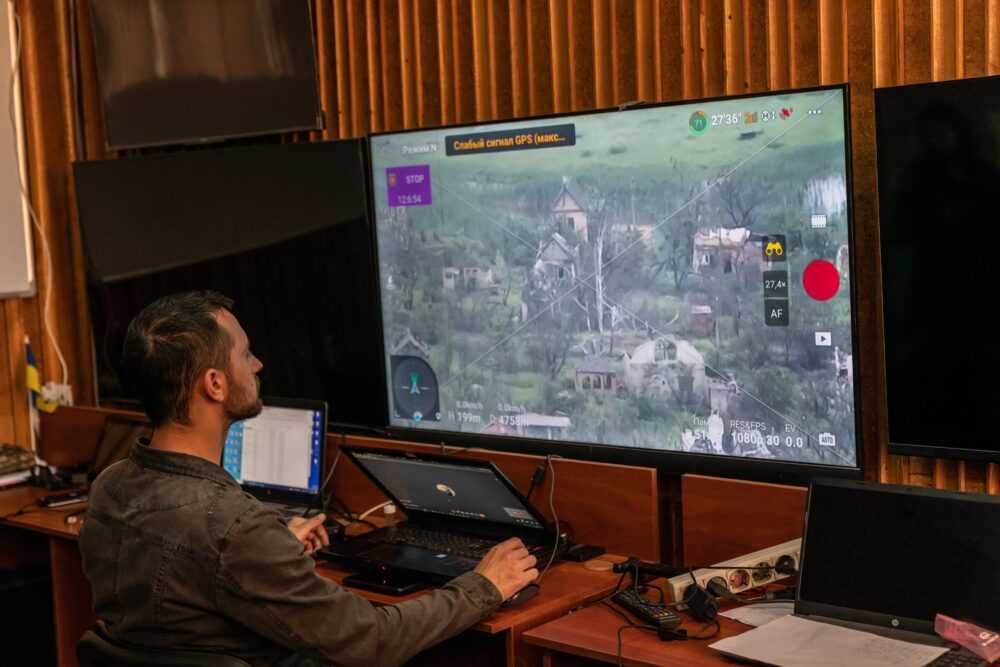
Just around the corner, a group of soldiers huddle around a glowing computer screen, watching a patchwork of videos of a destroyed city. This is Ukraine’s 24th Brigade, and from this underground command center in the town of Chasiv Yar, they are watching and controlling the endless battle of Bakhmut through dozens of drones.
“We’re looking for Russian vehicles,” 31-year old Roman, the primary drone operator for this command post, tells Paradox, sitting in a chair in front of the screen. “Once we find them, we’ll send the coordinates for [our] artillery,” he says.

The flatscreen display Roman and his colleagues are staring at is divided into a six-by-four grid, with enough places for 24 different video feeds to appear. Of these, 17 are presently active, operated by controllers in Bakhmut itself. They each show different sectors of the moonscape that is now Bakhmut, buildings ripped to pieces by months of bombardment.
In the top corner of each, a label indicates which unit the camera is watching. Most of them are companies from the 24th, but a handful of other brigades are present – detachments of the 127th Territorial Defense Brigade, the 5th Separate Assault Brigade and the International Legion, the latter present in Bakhmut for nearly half a year.
For the soldiers in these units, Roman and his men are their eyes and ears.
“We’re on the lookout mostly for vehicles, if we can find them, but there are less of them these days,” Roman says. “So now we also search for groups of infantry, anything bigger than five people. We have to search carefully for them, looking at all the buildings, through the holes [that have been blown in them],” he says.
In these latter stages of the Bakhmut battle, the enemy’s tactics have changed, both quantitatively and qualitatively. The Russians now come in smaller groups.
“Earlier we used to see groups of 15 or 20 [Russians] quite often – that was their standard size,” says Roman. “Now they’re smaller – only five or seven guys at a time. We find maybe six, seven groups per day of this size,” he says.
The tactics and capabilities of these groups also vary wildly.
“There are a lot more mobilized [Russian soldiers] than Wagner [mercenaries],” says Roman, describing how the latter were once the leaders of the Russian infantry assaults in the city. “You can tell them apart immediately by their uniforms – Wagner have professional kit, mobilized troops don’t even have standardized outfits – and by the way they act. Wagner are aggressive, competent, attacking with clear purpose and goals. The mobilized – they have no body armor, no order, no desire even to fire [their rifles],” he says.
It’s likely that Roman is describing also the division of troops within the Wagner Group mercenary outfit itself. Analysts have spoken of ‘two Wagners’ – one composed of the infamous prisoner conscripts that are thrown into battle with little to no training, intended to simply wear down the enemy by surviving as long as possible. The ‘other’ Wagner, that which Roman speaks of, is comprised of well-trained militants, often former soldiers, who have the skills and coherence to make actual gains once their Ukrainian opponents have been exhausted by combat with the first group.
But finding either group is becoming more difficult these days, owing not only to the scaling down of the Russian assault in this later stage of the battle for Bakhmut, but by the decreased lifespan of Ukraine’s drones themselves, as the enemy adapts.
Small commercial quadcopters have played an outsized role in the Ukraine war, utilized by both sides but especially by the defenders, who have often had to search for such innovative solutions in the face of a Russian material advantage. Models such as DJI’s Mavic 3T and Matrice 300RTK, two of the Ukrainian military’s favored variants, have enabled everything from reconnaissance to artillery spotting to makeshift air support, in the form of dropping grenades on enemies.
But Russia has adapted. Increased awareness of the drone threat has already lowered the lifespan of the average commercial quadcopter on military duty in Ukraine to just three flights before being brought down. Developments in Russian electronic countermeasures has diminished the range of said drones, forcing their operators to move ever-closer to the frontlines. One Ukrainian drone operator estimated in early April that the DJI drones so beloved by Ukrainian troops would become ‘not usable’ within just ‘three, four months.’
Watching from the screen in Chasiv Yar, it’s hard to imagine how the Ukrainian military will function without them – especially as a dramatic example of their usefulness unfolds.
A call comes in on one of the myriad walkie-talkies sitting on the desk beside Roman. A garbled voice from a soldier somewhere in Bakhmut itself reports that a group of Russians has just been spotted by the canal: “six men…walking one-by-one…heading towards the factory,” the unseen soldier reports. Roman clicks one of the drone feeds, expands it to fill the full screen, looking for something.
Suddenly, movement. A man appears on the third floor of a half-destroyed building, visible on a staircase showing through a massive gash in the outer wall. “Wagner,” says Roman, apparently having already identified the man by his uniform. Two of the man’s comrades appear next to him, swaying uncertainly as they peer out from the structure, looking for something in their surroundings.
Roman checks some information on the side of the camera feed and picks up another walkie, presumably connected to an artillery crewman. He begins calling in the coordinates of the building with the Wagner squad. Soon enough, the Ukrainian answer, in the form of a number of 155 millimeter shells, will come.
Unfortunately for this reporter, it is at this moment that the consistent cluster bombardment of the town above has ceased enough to allow relatively safe movement. Commanders with the 24th Brigade usher the reports out of the command post, to make use of this brief opportunity to retreat to safer pastures. They, and Roman, will stay here, keeping watch over Bakhmut – or what’s left of it.
