



It was my ninth day at Burning Man 2023, after many hours of partying amid the deluge, that I found myself climbing “The Cube,” a 60-foot-high white plastic art installation in the middle of the Playa. I was in search of a sunrise.
To say this was unwise is underplaying it. It was foolhardy. The Cube – one of many large and beguiling exhibits on the hard, sandy flats – was composed of many smaller building-block cubes, the sort that a farmer might keep in his yard, which were filled with water and lassoed together with metal wire and zipties. The Cube was meant to be admired, ideally from a distance, a shimmery spectacle in the wide Nevada desert. To climb it, you had to cling to the thin wires on the side and find footholds in the stirrups below, inching oneself up. Because my Burner boots were too wide for the job – and, in 2023, too muddy – this I did in my socks.
As a kid, I climbed trees like a proverbial monkey. But over the years (I’m now 49) I’d developed a fear of heights, even feeling uncomfortable going up some skyscrapers in New York. Now, on this bright, azure morning, I was 50 feet off the ground with no safety harness or net. Haltingly, I scrambled to the top, expecting a sanctuary to enjoy the magnificent view. But the top turned out to be just a single row of cubes, and the middle of The Cube, spanning about 100 feet across, was yawningly hollow. You could just as easily fall to your death inside The Cube as out of it.
I clung to the wires as the wind blew, the loose structure swaying side to side. I couldn’t move, too fearful to make a false step and starting to feel numb with fear, lightheadedness and comedown from all the drugs I’d taken. A stranger to my right, a 20-something Burner with long hair and no teeth, looked at me, concerned. “Joint?,” he asked, passing me a spliff. I took a small hit, still petrified, trying to appreciate the moment. It was now 8 a.m. The sunrise was cartoonishly large, a deep orange halo.
It wasn’t the first time I questioned what I was doing at Burning Man. On the third day, after partying the first two nights all-out, I plummeted so hard that I cycled around Black Rock City in a daze, taciturn and moody. I broke off from my friend Nadir and headed to a healing camp, where I cried inconsolably for an hour with a healer named Diamond. He told me I was a beautiful soul and that I should love myself. On several days afterwards, I welled up at odd moments, feeling unsure of myself and unhinged from what I knew to be certain and safe in life.
When the rains came on the seventh day, for nearly the first time in 24 years of Burning Man, the Playa turned into a quagmire, making the roads impassable. The porta-potty trucks couldn’t collect. Our tent filled with water from holes in the floor, making the mattress unsleepable. Our clothes – carefully assembled and shipped ahead by my partner, Lindsey – were soaked. As the temperature dropped, I shambled in the semi-darkness, unsure of where anything was. For four nights, we were forced to sleep in other peoples’ tents and RVs. Food was rationed. We peed in odd containers and bottles. There was no cell service or WiFi. And we couldn’t get out. Several rides we organized fell through. On Wednesday morning, not knowing who else to ask, I cycled to BMIR 94.5 FM (“The Voice of The Man”) and made an appeal over the airwaves. A young Indian guy and another couple heard our call and we finally left the site three-and-a-half days later than planned.

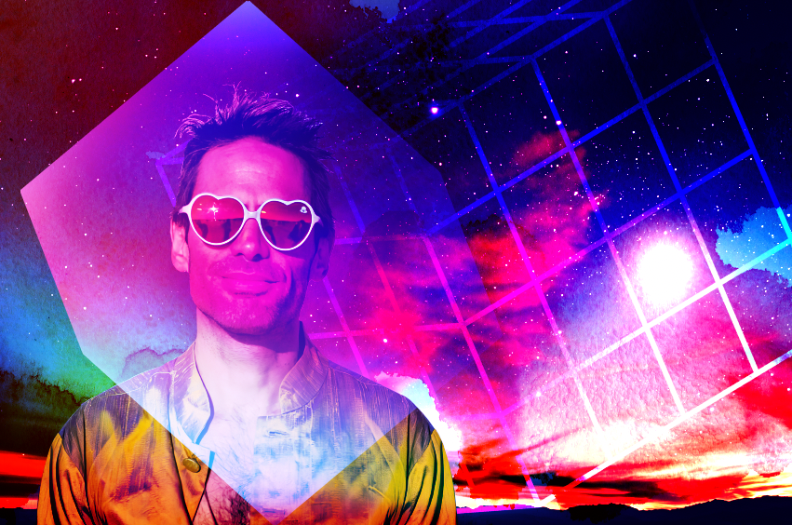
Ben Schiller navigates storms and strange encounters across Burning Man’s Playa. Photo rendered with DALL-E.
After 11 days in the pounding heat and thick mud, I was mentally, physically and spiritually drained. At times, I thought I’d lost my mind. But, once I’d slept, I was elated. Burning Man 2023 was one of the most important experiences of my life. We’d had a great time and, stripped of comfort and internet access, I felt renewed. I felt humble. I purged myself of stresses and traumas that had accumulated at home (I was divorced in the last year after 17 years of marriage). And I met some incredible people: bold, honest, caring and fun folk. Our camp of about 75 (La Calaca) rallied magnificently in the rains, displaying superb organization and everyone worked together. I got warming hugs when I needed them most. A lot of veteran Burners said it was the best one they’d been to, and I believed it. For all the inconvenience, I saw humanity in the extreme conditions and, when I got home, I wished the “real world” could be more like the camp.
As the rains came, Burning Man 2023 became international news. Reports emphasized the “chaos” at the site and bickering among Burners. They pointed to waste left on the Playa (“Burning Man’s privileged twits leave behind a trashed Nevada campsite” ran a New York Post headline) and its climate change impact. There was speculation that 2023 might be the last of Burning Man. Yet none of that squared with my personal experience. What I saw was more inspiring and hopeful. I saw a community working together to get through the challenge and have a good time. I saw the commonality and solidarity of people, their willingness to live according to the “10 Principles” of Burning Man, including “radical self-reliance” (that you have to take care of yourself before others), radical self-expression (anything goes as long as it’s consensual) and radical inclusion (if you can afford the $600 ticket, you’re equal like everyone else). It was these principles – individualistic, yet highly communitarian – that had carried us through.
In the public mind, Burning Man is often seen as a place of debauchery and wasted brain cells. People obsess over the nudity, drug use and orgy tent (which turned out to be more of a shack). But Burning Man is really about a community working together to create a beautiful, albeit temporary, reality. The event isn’t really a rave or music festival. It’s an art festival and platform for social creativity. In the absence of monetary exchange, offerings of free drinks and food, music, massages and many other impromptu services become whimsical acts of imagination. If only more human interactions were like that, I thought.
At night, the Burning Man site seems limitless. Looking out across the Playa, the encampments appear to extend for miles, like Chicago. The flatness of the desert gives a sense of infinity, like a metropolis that goes on forever. And yet this limitless city is entirely ephemeral. At the end of the event, Burners dissemble everything, leaving hardly a trace. Most Burners are extremely conscientious to pick up “matter out of place” (MOOP), going down on their hands and knees to pick up small fragments of plastic, paper and glass. So, it seems churlish to concentrate, as many media accounts have, on how, in 2023, some waste was apparently left behind. It could have been so much worse, and, at any normal music festival, it would have been. Instead, the vast majority of attendees peed into bottles and defecated in toilets, keeping the Playa clean for another year. If only people IRL acted with such restraint.
My favorite moment of the week came immediately after I left Diamond at the healing camp. Cycling down the street, I came across a site where volunteers offered a foot-washing service. If you don’t care for your feet at Burning Man, the desert’s alkaline dust can cause a kind of chemical burn known as “Playa Foot.” So a foot-washing service is supremely useful. I took off my socks and placed my feet in a plastic tub. A friend washed my feet with vinegar and soapy solution, then applied a lotion. It felt great. I decided to become a foot-washer myself, cleaning and massaging three other Burners’ feet the same way. It made me feel good to give something back like that, and it made me feel good about the event. Burning Man is powered by this sort of reciprocal gifting and by the connections these acts create between human beings. If more people acted this way in real life, I thought, the world really might be a better place. The media never reported on that side of the story and that’s an indictment of them. When you search for the worst in people, you will surely find it.

Ben Schiller rendered by Joanna Andreasson for Paradox.
